

At about 9am all the cars would rendezvous at Retreat shopping centre, Dad would buy the Sunday Mail (published in Salisbury) and the Sunday News (published in Bulawayo), then set off on the 50 minute drive to the Matopos National Park. If we were lucky we would see the small herd of sable that often grazed close to the confluence of two roads near the entrance to the park. On the way we passed the Matopos Hotel with its large verandah overlooking the dam. We never picnicked at Matopos Dam for some reason – perhaps because it was a favourite spot for sailors, which we certainly weren’t. The main road to the Matopos was tarred, but the smaller roads were dirt. In the 1950s many of the colony’s roads were still “strip” roads. These had been devised back in the 1930s when the Chief Road Engineer of the day hit upon the idea of surfacing many of the well-worn tracks that served as roads. At first concrete was used, then tar. The strips were an axle length apart, and when oncoming traffic approached, each vehicle moved to the left so only the nearside wheel was traveling on a strip, and they passed in the cloud of dust raised by the offside wheels on the dirt! This tactic always caused a sharp intake of breath and clutching of the door handle by Mom, but Dad was a good driver who adjusted to the new driving challenges with aplomb.
We had, in our first months in Rhodesia, visited Rhodes’ Grave, which is situated at the top of a granite kopje with spectacular views for 360 degrees all around. To reach the top meant a 20 minute walk up the sloping rock, and we attacked this with gusto, scampering back and forth across the large expanse of lichen-covered solid rock. Huge blue-headed lizards watched our progress, scuttling away under boulders when we tried to approach them. We would pick sprigs of Resurrection Plant to take home. Growing on the kopjies it looked grey and dry, but once put into water it became green and soft.
At the gravesite the silence was absolute, broken only by the sound of the wind and the murmur of voices as everyone felt the peace and spirituality of the area enfold them. We would try to imagine what it was like on the day of Cecil John Rhodes’ funeral as the natives carried his coffin up to his chosen resting place, and the mourners followed slowly behind to pay their last respects to the great man. A short distance from the grave is the Shangani Memorial, a four-sided monument encircled at the top by a bronze frieze depicting the brave last stand of Allan Wilson and his men against 7000 Matabele warriors at the Shangani River.
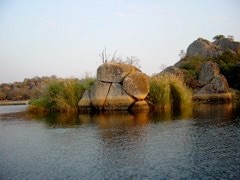
Although there were picnic sites at the foot of the kopjie, we hardly ever chose to stop here, preferring to go to a site near water. The Ovi River and Toghwana Dam were popular choices, but the favourite amongst us children was Maleme Dam. Maleme had everything - a large dam, trees, and endless granite rocks to climb. The convoy would roll cautiously down the approach road, past the rest camp and the dam wall to the left, and onto the dirt road that cut across the scrubby grass surrounding the dam. All around the dam rose great granite hills covered in acacia trees and aloes, home to monkeys, baboons and leopards. It paid to get there early to choose our picnic spot. Ideally this was flat, with enough trees for each car to park in the shade, and with climb-able rocks close by. Car doors would open as soon as we stopped, and after submitting to a layer of suncream on our faces, we would be off swarming over the nearest kopjies. The best picnics were when Auntie Ada and Uncle Willie came, bringing our cousin Clive. Having no brothers, we hero-worshipped him, and Clive could climb rocks and trees with barefooted simian agility. For the next hour we would explore the sun-warmed rocks, stopping now and again to climb one of the “paper” trees protruding from a crevice between kopjies. Although I was a child uneasy with physical activity, even I loved making my way up and over the rocks until we all reached the top and could sit looking down on the adults. By now the women would all be in folding chairs chatting as the men got a fire going and put the kettle on to boil. The silence was broken only by our chatter and the occasional bark of a baboon, but high up on a kopjie we couldn’t hear the adult conversation at all. I always preferred to be within sight of our picnic spot, however far away, and when occasionally our explorations took us behind the boulders, the isolation made me nervous. My vivid imagination would conjure up scenarios of broken legs, baboons and hungry leopards lurking in the granite caves. The biggest dread was the thought of seeing a snake, which would surely bite my leg and render me moribund within seconds, perhaps unnoticed by the other children who invariably climbed faster and higher than me!
Increasing thirst and hunger drove us back to the adults. Unfailingly one of us would have a cut or scratch that needed an application of TCP and a plaster, and we would try to hide the inevitable torn shorts caused by sliding down granite slopes. If lunch was a braai, delicious smells would by now be wafting around, and we could hardly wait for the meat to be cooked so we could have a wors roll or steak sandwich. After lunch we would loll around for a while before our natural energy kicked in again, and we were ready for more activities. Sometimes the menfolk would propose a walk, and would take the children off for an hour or so to walk round the farthest end of the dam, or across the dam wall. From the other side we would shout and wave frantically at the Moms relaxing under the acacia trees, occasionally swatting at the mopani flies around their heads.
Other times there would be a ball game or races, but the one thing we were never allowed to do was swim in the dam. Before we ever ventured out into the Matopos during our first days in the colony, we had been warned again and again about the danger of swimming in rivers and dams. The main hazard was the ubiquitous bilharzia, part of whose parasitic lifestyle was spent in slow-moving water. Bilharzia was a nasty condition that caused extreme fatigue and could lead to urinary problems, and in those days the treatment was worse than the disease itself. My mother, fresh from Ireland, was all too susceptible to warnings of dire tropical dangers, so we would never have dared to venture even a toe into water in Rhodesia. Crocodiles were not unknown in rivers and dams, and occasionally there would be a report of some poor African child being “taken by a croc” as they played at the water’s edge near their home.
Following their exertions the men would return wanting a cup of tea, and we all sat round drinking tea or “cool drinks”. Each family had brought cake or biscuits for afternoon tea. Mom usually made a boiled fruit cake or crunchies, but of course we always wanted to try what friends had brought – Mrs Hawkins’ “hermits” or Mrs Lynch’s rock cakes always tasted better to us than our contribution!
At about 4pm the sun would be slipping down towards the horizon and the packing up would start. We would head off to the rocks for a last climb (and, of course, to avoid helping!), admonitions of “Now, don’t go far, we’re going soon!” ringing in our ears. Finally we would all be packed into the cars and the return journey would begin. If we were at Maleme we had the delicious anticipation of climbing the hill out of the dam area back to the main road. The hill was a cement road at an angle of about 40 degrees, and while most of the cars could get up it in first or second gear as we all held our breath, an older car might grind to a halt, and the occupants would be ordered out to walk while the driver gingerly encouraged the car up past the summit. Feeling tired, dirty and sunburnt, my sister or I would try to be first to say “Bags me first in the bath” as this helped to ensure a reprieve from unpacking the car when we got home, but Dad rarely fell for that, and we all had to help. Supper was invariably sandwiches before we fell into bed after this most perfect of days.
Jan Tudor-Owen